On Friday September 23rd, the CUPE National Executive Board “passed a unanimous resolution vowing to defy the Liberal government’s Bill C-39 limiting the constitutional right to strike if it is passed unamended through Parliament.”
The Executive Board of CUPE 4600 is proud to stand in solidarity with our union siblings in the federal public service and federally regulated private sector who will have their right to strike severely restricted if the federal government passes Bill C-39 unamended. While the university sector is provincially regulated, we recognize that any legislation at the federal level that gives a minister such sweeping overreach may one day be replicated in sectors such as our own. Being located in the national capital region, we are keenly aware of the impact this legislation will have on collective bargaining rights for over 140,000 federal public service union members.
In 2015, the Supreme Court of Canada recognized that the right to strike was constitutionally protected. In a 5-2 decision, the Court ruled that the right to strike falls under section 2(d) freedom of association of the Canadian Charter of Rights and Freedoms and that it should be “limited as little as possible.” The Canadian Labour Congress has found that “Bill C-39 would give the Canadian government the broadest strike intervention powers” compared to every other G7 country, including the United States. You can read more of that analysis here.
In 2022, CUPE 4600 joined a multitude of other unions across the province in rising up against the Ontario Conservative government’s attempt to curtail the right to strike. The proposed Bill-28 would have prohibited looming job action and would have imposed a contract on 55,000 education workers facing a hostile employer led by Education Minister Stephen Lecce. The massive cross-sector union response to these draconian measures was successful, and the Ford government’s attacks on the right to strike were defeated.
We oppose the federal government’s attempt to limit the right to strike via this “flooding-the-zone” omnibus bill and call for the amendment of Bill C-39 to remove threats to the right to strike, as well as for the repeal of Section 107 of the Canada Labour Code, which gives the federal minister undue authority to intervene in the collective bargaining process.
You can take action by writing to Prime Minister Mark Carney, Minister Patty Hajdu, and your local MP to demand that fair deals be settled at the bargaining table and not in the boardroom. Today, as in 2022, our local is ready to take action to protect every worker’s right to strike and to fight for better working conditions.
Welcome (back) Unit 2 members of CUPE 4600, the largest union on campus! As a member of CUPE 4600, you are part of a strong collective of over 3000 education workers who keep the university running. Here are a few things to keep in mind as we start the new academic year.
Get to know your union: CUPE 4600 represents all teaching assistants, internally-funded research assistants, and service assistants (Unit 1), and contract instructors (Unit 2) at Carleton University.
Health and dental benefits are administered through CanBen. All Contract Instructors are eligible for these benefits, you will receive enrollment details directly to your inbox.
Changes to the Professional Development Fund: Unit 2 members can apply for funds to support their professional development or support teaching related costs. The Fund is now administered fully by the Union, and applications can be submitted via a Google Form or fillable PDF found on our website.
Note on Previously Denied Claims: In the past, Contract Instructors have been unfairly denied access to the professional development fund. To address this issue, all CIs who have had an application denied in the past two years can resubmit that denied claim up until December 15th 2026. See our website for more.
The new application forms will open as of September 1, 2026
Applications for Accommodations: If you are applying for an accommodation of any kind, be sure to include CUPE 4600 (info@cupe4600.ca) on the application. Remember: all employers in Ontario are legally required to meet accommodation requests from their employees to the point of “undue hardship.”
Stay up-to-date on Union matters: bookmark our Events Calendar, Follow our instagram, and keep an eye out for the bi-weekly union-wide digest, and monthly update emails for Unit 2 Members.
Not getting our emails? If you have previously unsubscribed from our email distribution list, you may be missing out! Contact us (info@cupe4600.ca) to get back on the list.
Help update our list of Stewards!
One of our goals is to refresh, renew, and expand our Steward list. If you have been, or wish to be a Department Steward, please check in with us by emailing our Chief Steward, Mark Blenkinsop at ci.chief.steward@cupe4600.ca. Positive check-in and confirmation from current stewards is required. Thanks to all who have already contacted us – we look forward to hearing from anyone wishing to join!
What a steward does:
Stays in touch with fellow CIs in your department
Keeps an ear out for what everyone is saying
Stays in the know on the union, and keeps us in the know behind the scenes
Hello to all TAs, Internally-Funded RAs, and Service Assistants
To new members, welcome to CUPE 4600, the largest union on campus. All TAs, Internally-Funded RAs, and Service Assistants are automatically Unit 1 Members of CUPE 4600, you do not need to do anything to sign-up.
Important start of term information:
Take screenshots of your TA Assignment and Assignment of Duties (AOD) on Carleton central. This may protect you from errors or changes that have not been discussed with you which could affect your schedule/hours.
You should get an AOD that includes all duties related to a course. All the work required for your TA assignment needs to be covered here, including for example preparation time and time answering emails. If the grading times or preparation times are unreasonable, inform your course supervisor and request alterations to the hourly breakdown of duties. See our AOD Guidelines Sheet.
Protect yourself from overwork – track your hours! We’ve got a fillable spreadsheet in multiple formats on our website!
New this year: internally-funded RAs are now entitled to an AOD and the pre and midterm meetings. Please let us know if you have difficulty getting an AOD from your supervisor.
The assignment of duties is not a contract. As union members we have a collective agreement that lays out our pay, rights, benefits and protections.
We also have a TA Quickguide, a comprehensive summary of the collective agreement that should answer most questions. For returning Members, note especially the changes since the last collective agreement listed on page 4 of the Quickguide.
If you’d like to get more involved with your union, you can become a departmental steward or join a caucus or committee. Visit our “get involved” page for more information about either.
President Aidan Power and co-VP-Internal Ariel Rabkin-Meyer attended the 62nd annual CUPE Ontario Convention from May 26th to 30th, 2026. We met other academic locals representing teaching assistants and contract instructors including CUPE 2626 at the University of Ottawa, CUPE 3902 at the University of Toronto, CUPE 3903 at York University, CUPE 3908 at Trent University, and CUPE 4207 at Brock University. It was exciting to be able to share our recent wins on AI, academic freedom, and standardized online job postings with the other academic locals and hear from them about their ongoing efforts to combat austerity at their institutions. Moreover, it was heartening to hear of the successes of other locals in the sector in securing bargaining wins, in part through impressively organized strike practices. We are hopeful that the connections we made with these locals will be invaluable in strengthening our two units this coming academic year.
We supported resolution number 15 put forward by CUPE 2424 at Carleton calling for adequate funding and policies to support post-secondary institutions in Ontario. This was the only post-secondary specific resolution, which was disappointing, but further demonstrates the need of academic locals across the province to be coordinating far in advance of the Convention. Another resolution we supported was number 56 put forward by CUPE 2626 at uOttawa condemning the war on Iran and standing in “solidarity with the working class and people of Iran and supporting their right to freedom, equality, and self-determination without state repression or foreign interference.” There was also emphasis on preparing for the upcoming 2026 municipal and school board elections, with CUPE Ontario supporting locals who are seeking to endorse or run candidates. Given that CUPE 4600 has not traditionally endorsed candidates in elections, it is unclear at this time if or how we would engage this coming Fall.
There were no resolutions passed regarding AI, however paragraph 27 of the Action Plan states that “We must fiercely bargain protections against algorithmic management to ensure that any technological shifts benefit workers and the public good” and an amendment to the Plan was made that states we will “combat the corporate weaponization of Artificial Intelligence by demanding strict legislative protections against both the algorithmic harms and the massive ecological drain of AI infrastructure.”
Furthermore, as delegates noted multiple times on the floor, there were few resolutions put on the floor which directly address climate change. Resolution 21, which called on CUPE Ontario to publicly oppose Canada Pension Plan’s Investment Board’s investments in the fossil fuel industry, was carried. Resolution 2, which advocated for a “New Deal for Municipalities,” including “predictable, long-term funding for infrastructure, housing, transit, public health, and climate resilience,” was not voted on due to time.
We attended a picket line in support of developmental service workers represented by OPSEU Local 511 at Surrey Place and the following day also attended the Ontario Health Coalition Rally at Queen’s Park. Aidan also attended the International Solidarity Forum hosted by Avi Lewis, where panelists spoke on the situations in Cuba, Iran, and Sudan.
The over 900 voting delegates elected former secretary-treasurer Yolanda McClean as the new President, replacing the outgoing Fred Hahn, and Dawn Bellerose as the new secretary-treasurer. We supported fellow academic sector worker Jeff Cornelissen in his run for member-at-large, however he finished 7th out of a long list of candidates for 6 positions.
It is unclear what mechanisms of accountability are in place to ensure that resolutions passed at this convention will be honoured into the future, as several delegates brought up past resolutions that were not being honoured, particularly around accessibility and inclusivity. While these concerns were addressed positively in the moment by the chair, affirming the provincial organization’s commitment to protecting the rights and equity of its delegates, it is unclear what, if any, concrete action will be taken to ensure these are not overlooked in the future.
We were disappointed in the lack of time management for voting which disenfranchised delegates who were spending time and money to attend the convention in downtown Toronto. Resolutions that we were looking forward to debating and voting on that did not hit the floor before losing quorum on Saturday morning (after only 1.5 hours) included an emergency resolution in support of the OPSEU Worth Fighting For campaign; resolution 2 listed above; resolutions 46 & 50 defending freedom of expression, civic engagement, and the right to protest; and resolution 55 supporting the Arms Embargo Now campaign and declaring “arms shipments to Israel to be ‘hot cargo,’ not to be touched by workers of conscience.” Furthermore, it is only this year that a constitutional amendment was passed creating an accountability measure for reporting on resolutions which are not voted on at convention. The Provincial executive board votes on these unresolved resolutions and they are now required to report on the outcome of their votes by the end of the year. We discussed this with delegates who had attended previous conventions, and they reported that time management for voting has been an ongoing issue which the Provincial Executive has failed to address. While each sector had unread resolutions, it was clear based on the response of delegates that there are several sectors which are continually overlooked, including the university sector.
As one of the larger academic locals in the province, it is vital that we continue to send delegates to push for change, accountability, and further respect for our sector from the Provincial and National union bodies.
Thanks to the work of your bargaining team in the last round of negotiations there have been changes to the requirements for Carleton’s contract instructor position postings that will make the application process clearer and more standardized. It is important that CIs review and follow the application process as it is listed in the job posting as it may be different from previous years.
These changes include:
A regular posting window. All Fall and Winter courses must now be posted by May 1st (or the next working day) and remain open until May 31st (or the next working day). All Summer courses must be posted by December 15th and remain open until January 31st. (see sect. 15.2.c.)
Protections for posted courses. After a course has been posted, it cannot be “assigned to faculty members, doctoral students, postdoctoral fellows, and/or visiting scholars unless the applicant pool for the competition has been exhausted.” (see sect. 15.2.c)
Information about course schedule: Five days before the posting period ends, the university must share the public course schedule so you have information about when a course will be held. (see sect. 15.2.f)
More clarity in course posting: On top of the information it was already required to share (such as the course name, description, modality, qualifications, application procedure and deadline, and information about incumbency), the University is now required to ensure every posting also includes:
the type of posting (regular or late);
the academic term(s) the course will be scheduled;
the posting dates and revised date, as applicable;
the assigned credit value for the course; (see sect. 15.2.g)
If the posting has been assigned to a doctoral student, postdoctoral fellow, and/or visiting scholar and is not open for application. (see sect. 15.2.h)
Late Postings: Late postings are now considered postings that fill positions that became available after May 31st (or January 31st) but within 6 weeks of the start of classes (formerly 10 weeks).
Applications: In new applications, Contract Instructors should indicate all the courses that they want to be considered. (See sect. 15.4.b)
Contract Offers: The University is now required to offer contracts within the following timelines:
Regular Postings: no later than thirty (30) calendar days after the closing date for applications.
Late Postings: no later than fourteen (14) calendar days after closing date for applications.
Contract Acceptance: The applicant is now required to accept the contract offer within the following timelines:
Regular Postings, applicants shall reply electronically within seven (7) calendar days of receipt of an offer of employment.
For contract offers relating to Late Postings applicants shall reply as soon as possible, and no later than three (3) calendar days after receipt of an offer of employment.
Emergency hires: The new collective agreement created the classification of Emergency Hires. Other changes include:
Applicants must accept offers of employment for emergency hires within 3 calendar days.
Offers of employment must be made within 5 days of the contract start date and the Employer must try to make them with adequate time for preparation.
If you encounter any issues or irregularities please contact Unit 2 Chief Steward Mark Blenkinsop (ci.chief.steward@cupe4600.ca) or our Business Agent Pierre Blais (bao@cupe4600.ca)
From February 26th to March 1st, Co-Chief Stewards for Unit 1, Lauren O’Reilly and Serena Karevich, attended the Ontario University Workers Coordinating Committee (OUWCC) Annual 2026 Conference. It was an opportunity to connect with the leadership from other Ontario CUPE locals in the University sector. These locals represent a variety of members from teaching assistants, research assistants, and contract instructors like CUPE 4600, to academic administrators, food service workers, maintenance workers, and many more workers integral to the everyday functioning of our campuses. We were able to connect based on shared challenges, shared experiences, and the dedication to improving and protecting the working conditions of all workers in our sector.
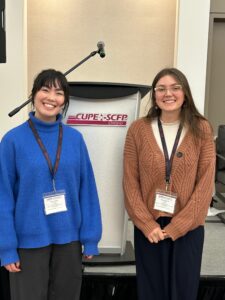
Unit 1 Co-Chief Stewards Lauren O’Reilly and Serena Karevich at the OUWCC Conference
During the conference, we learned about key issues impacting the University sector such as provincial underfunding, changes to international student visas, the marketization of education and research, real estate expansion and monetization, focus on ‘efficiency’, focus on new buildings and automation, over-investment in professional programs and micro-credentials, performance-based funding, and lasting impacts of Bill
We also learned about how these issues are impacting the workers across campuses such as the high increases in burnout, mental health challenges, and increased workloads often leading to deteriorating workplace safety conditions.
Artificial Intelligence (AI) was a big issue throughout the conference. A detailed presentation discussed the ways in which AI is being used in management systems to monitor and evaluate performance metrics, poses risks to job security, and is powered by workers’ data from multiple sources on campus such as network and server logs.
The presentation discussed ways to include language in CAs or LOUs that would protect against the use of AI. Lauren and Serena presented briefly on Unit 1’s LOU on AI from this most recent round of bargaining.
The impact of Ford’s new policies and bills on both our sector and all of Ontario was another key theme. While there will be an increase to the amount of funding universities will receive, this funding is still well below the funding levels prior to 2018 and fails to account for inflation. Cuts to OSAP grants and the removal of tuition caps will place the burden of funding universities on the shoulders of students and working families already struggling.
Additionally, the Conservatives’ Bill 60 poses risks to Ontario’s public water. This bill will allow private, corporate control over Ontario’s water systems, risking deregulation and ignoring the previous Walkerton disaster.
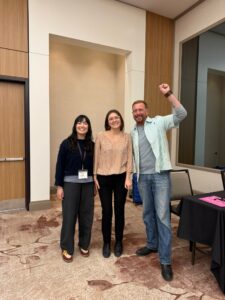
Lauren and Serena with Ryan Culpepper, CUPE Ontario University Sector Coordinator
There were several workshops offered throughout the conference including a (1) workshop on strategic financial research/use of financial data and (2) another on power mapping in the context of university governance. The workshop on the strategic use of financial data focused on leveraging finances as the thing which the employer cares about the most by doing things such as drawing on publicly available financial data that reflects poorly on the employer as well as creating financial risk for the employer where possible (e.g. by threatening to report the employer to their credit agency).
The second workshop on power mapping in the context of university governance asked the delegates from each university to conduct a power mapping exercise to identify where power is consolidated in each respective campus and how to use this structure of decision-making power effectively. The exercise asked delegates to consider what pressures each division of university governance was responsive to and correspondingly how member-driven campaigns can be directed effectively towards the right centers of power.
There were also individual workshops that Lauren and Serena each attended, including a workshop on workplace violence (WPV) and another on the “state of readiness”. The WPV workshop discussed the risk factors and the obligations of the employer to prevent workers from being exposed to and injured by violence in the workplace. The state of readiness workshop had Locals assess their “state of readiness” in terms of structures, tools, skills, and capacity for defensive or offensive campaigns that require mass mobilization and majority participation.
Finally, the conference had multiple presentations throughout, including a retiree presentation, a presentation on climate justice, a presentation on CUPE’s Anti-Racism Organizational Action Plan (AROAP), and a presentation on recently passed Bill 60.
The presentation on climate justice identified the various manifestations of the climate crisis in our daily lives as workers, considering CA language around extreme weather protections where applicable and importantly recognizing the role of pension funds investments in sustainability. The AROAP presentation highlighted their Women in Leadership Development Program and anti-racism education which is available to all members. The presentation encouraged Locals to forward AROAP principles in various ways, such as by inviting AROAP to come speak to their Local, electing an equity representative in their Local, and connecting with the AROAP team about reviewing their bylaws.
While briefly discussed earlier in the report, the presentation on Bill 60 highlighted how Locals can raise this issue (and similar ones) to contribute to collective action across Ontario by doing things such as putting this item on their agendas and adopting motions to engage city council.
Overall, the conference was a great opportunity to connect with other Locals across the Ontario university sector and work collaboratively towards solving issues in common.
We are pleased to announce that the Tentative Agreement reached by the elected bargaining team was overwhelmingly approved by the membership during this week’s ratification vote. Of the members who voted, 93% cast a ballot in favour of the new agreement.
Once the University’s Board of Governors formally ratifies the Tentative Agreement, we will begin preparing the finalized 2025-2028 Collective Agreement document that will be shared with the membership on our website as soon as it is completed and signed by all parties. In the interim, you can still review the “summary of changes” document that was provided to the membership here.
Thank you to all who participated in the ratification vote.
As you know, Unit 1 has been bargaining for a new Collective Agreement since September. After bargaining for 13 hours today (January 27) your Bargaining Team reached a Tentative Agreement with the University thanks to the help of Paul Pooler, a Ministry of Labour-appointed conciliator.
The details of the Tentative Agreement will be shared at a Unit 1 Special Membership Meeting to be held on Tuesday, February 3, 2026. At this meeting, your Bargaining Team will highlight the changes that were mutually agreed to and will take questions. Immediately following this meeting, a ratification vote will take place online through the Simply Voting platform over a period of three days. The results of the ratification vote will be announced immediately following the vote.
Once both the Union’s members and the University’s Board of Governors ratify the Tentative Agreement, it officially replaces our previous Collective Agreement. Should the membership vote down the agreement, both bargaining teams must re-assemble to re-start negotiations.
This Tentative Agreement comes with the full endorsement of your elected bargaining team, and we are excited to share the details with you.
In solidarity,
Ariel Becherer,
Lead Negotiator & VP Unit 1
The Union is pleased to announce that the Tentative Agreement reached by the elected bargaining team for Unit 2 was overwhelmingly approved by the membership during last week’s ratification vote. Of the members who voted, 98% cast a ballot in favour of the new agreement.
As of last week, both the Union and the University’s Board of Governors have ratified the Tentative Agreement. We will now begin preparing the finalized 2025-2028 Collective Agreement document that will be shared with the membership on our website as soon as it is completed and signed by all parties. In the interim, you can still review the “summary of changes” document that was provided to the membership here.
Thank you to all who participated in the ratification vote.