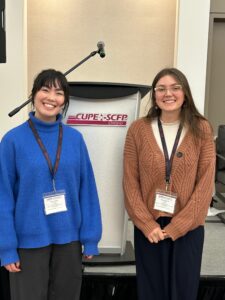
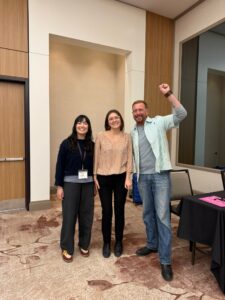
From February 26th to March 1st, Co-Chief Stewards for Unit 1, Lauren O’Reilly and Serena Karevich, attended the Ontario University Workers Coordinating Committee (OUWCC) Annual 2026 Conference. It was an opportunity to connect with the leadership from other Ontario CUPE locals in the University sector. These locals represent a variety of members from teaching assistants, research assistants, and contract instructors like CUPE 4600, to academic administrators, food service workers, maintenance workers, and many more workers integral to the everyday functioning of our campuses. We were able to connect based on shared challenges, shared experiences, and the dedication to improving and protecting the working conditions of all workers in our sector.
During the conference, we learned about key issues impacting the University sector such as provincial underfunding, changes to international student visas, the marketization of education and research, real estate expansion and monetization, focus on ‘efficiency’, focus on new buildings and automation, over-investment in professional programs and micro-credentials, performance-based funding, and lasting impacts of Bill
- We also learned about how these issues are impacting the workers across campuses such as the high increases in burnout, mental health challenges, and increased workloads often leading to deteriorating workplace safety conditions.
Artificial Intelligence (AI) was a big issue throughout the conference. A detailed presentation discussed the ways in which AI is being used in management systems to monitor and evaluate performance metrics, poses risks to job security, and is powered by workers’ data from multiple sources on campus such as network and server logs.
The presentation discussed ways to include language in CAs or LOUs that would protect against the use of AI. Lauren and Serena presented briefly on Unit 1’s LOU on AI from this most recent round of bargaining.
The impact of Ford’s new policies and bills on both our sector and all of Ontario was another key theme. While there will be an increase to the amount of funding universities will receive, this funding is still well below the funding levels prior to 2018 and fails to account for inflation. Cuts to OSAP grants and the removal of tuition caps will place the burden of funding universities on the shoulders of students and working families already struggling.
Additionally, the Conservatives’ Bill 60 poses risks to Ontario’s public water. This bill will allow private, corporate control over Ontario’s water systems, risking deregulation and ignoring the previous Walkerton disaster.
There were several workshops offered throughout the conference including a (1) workshop on strategic financial research/use of financial data and (2) another on power mapping in the context of university governance. The workshop on the strategic use of financial data focused on leveraging finances as the thing which the employer cares about the most by doing things such as drawing on publicly available financial data that reflects poorly on the employer as well as creating financial risk for the employer where possible (e.g. by threatening to report the employer to their credit agency).
The second workshop on power mapping in the context of university governance asked the delegates from each university to conduct a power mapping exercise to identify where power is consolidated in each respective campus and how to use this structure of decision-making power effectively. The exercise asked delegates to consider what pressures each division of university governance was responsive to and correspondingly how member-driven campaigns can be directed effectively towards the right centers of power.
There were also individual workshops that Lauren and Serena each attended, including a workshop on workplace violence (WPV) and another on the “state of readiness”. The WPV workshop discussed the risk factors and the obligations of the employer to prevent workers from being exposed to and injured by violence in the workplace. The state of readiness workshop had Locals assess their “state of readiness” in terms of structures, tools, skills, and capacity for defensive or offensive campaigns that require mass mobilization and majority participation.
Finally, the conference had multiple presentations throughout, including a retiree presentation, a presentation on climate justice, a presentation on CUPE’s Anti-Racism Organizational Action Plan (AROAP), and a presentation on recently passed Bill 60.
The presentation on climate justice identified the various manifestations of the climate crisis in our daily lives as workers, considering CA language around extreme weather protections where applicable and importantly recognizing the role of pension funds investments in sustainability. The AROAP presentation highlighted their Women in Leadership Development Program and anti-racism education which is available to all members. The presentation encouraged Locals to forward AROAP principles in various ways, such as by inviting AROAP to come speak to their Local, electing an equity representative in their Local, and connecting with the AROAP team about reviewing their bylaws.
While briefly discussed earlier in the report, the presentation on Bill 60 highlighted how Locals can raise this issue (and similar ones) to contribute to collective action across Ontario by doing things such as putting this item on their agendas and adopting motions to engage city council.
Overall, the conference was a great opportunity to connect with other Locals across the Ontario university sector and work collaboratively towards solving issues in common.